CHEESEBURGER: CLPS-enabled Highly-autonomous End-to-End ISRU-System Evaluations to Build Understanding and Resilient Growth by Experimenting with Regolith

CHEESEBURGER (Oct 2025 – Jun 2026)
CLPS-enabled Highly-autonomous End-to-End ISRU-System Evaluations to Build Understanding and Resilient Growth by Experimenting with Regolith
Best in Theme for Lunar Technology Demonstrations Leveraging Common Infrastructure, at NASA's 2026 RASC-AL Forum, the culminating event of the NASA Revolutionary Aerospace Systems Concepts - Academic Linkage competition.
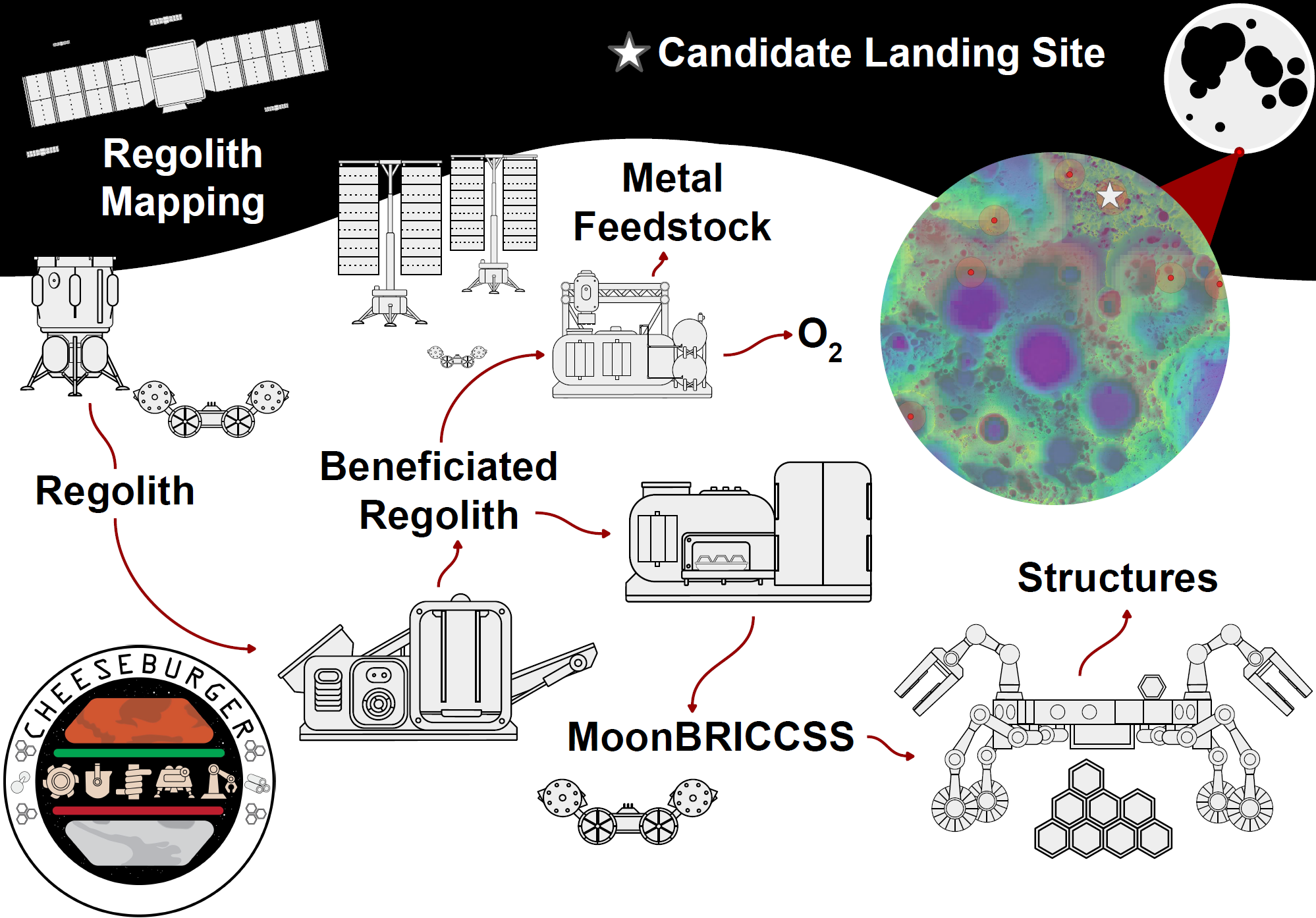
The fastest way to make a lunar base unaffordable is to bring everything it needs from Earth. The Moon's own regolith can supply oxygen to breathe and burn, metal to build with, and dense material to hide behind from radiation, but a supply chain that does this is usually proposed as one large plant to be demonstrated whole. CHEESEBURGER takes it apart. The campaign is five robotic payloads, each a standalone technology demonstration that advances a lunar infrastructure objective on its own, and that together compose the first end-to-end lunar industry.
Each payload does one job, and the names, coined on a January team trip to Sandwich, Massachusetts, describe the hardware more plainly than a wall of acronyms would. SWISS prospects for the richest ore. BRIOCHES extracts, enriches, and conveys the regolith. BACON melts and casts it into bricks. GRILLED MEAT runs molten regolith electrolysis to pull out metal and oxygen. AVOCADO is the autonomous builder that stacks the products into structures, including the interlocking MoonBRICCSS that shield a habitat. Because the five are independent, the campaign tolerates a schedule slip or a failed landing, allows each subsystem to be tested mid-campaign, and still advances the program if only some of them fly.
The design rides shared infrastructure rather than rebuilding it, drawing on fourteen common elements including NASA's IPEx excavator for bulk regolith, VSAT for power, and LunaNet for communication. The five payloads total 3,123 kilograms, draw 224 kilowatt-hours, and return 30,000 megabits per day, at an estimated $3.4 billion with a 30 percent margin, sited at the Mons Mouton plateau near the south pole. The primary objective is to demonstrate at least three payloads; the extended objective lands all five payloads and integrates them into a working pipeline, with the oxygen, iron feedstock, and shielding bricks feeding the Artemis Base Camp material-testing campaign in 2032 and 2033.
Leadership & Team
CHEESEBURGER was led by Cesar Meza, a graduate student in Aeronautics and Astronautics, and Elizabeth Romero, an undergraduate in the same department. The team was Rachel Dunphy, Shreya Kothnur, Christopher Kwon, Marvin Martinez, Lanie McKinney, Hailey Polson, Ananda Santos Figueiredo, Jose Soto, and Evangeline Haiqi Wang, spanning AeroAstro, Mechanical Engineering, the Technology and Policy Program, and Wellesley College.
I supported this team on a day-to-day basis as their sponsor, mentor and lead advisor. Joining me were faculty advisors Prof. Jeffrey Hoffman and Prof. Olivier de Weck.
Project materials
Technical paper · Technical poster · Chart deck · Forum presentation